

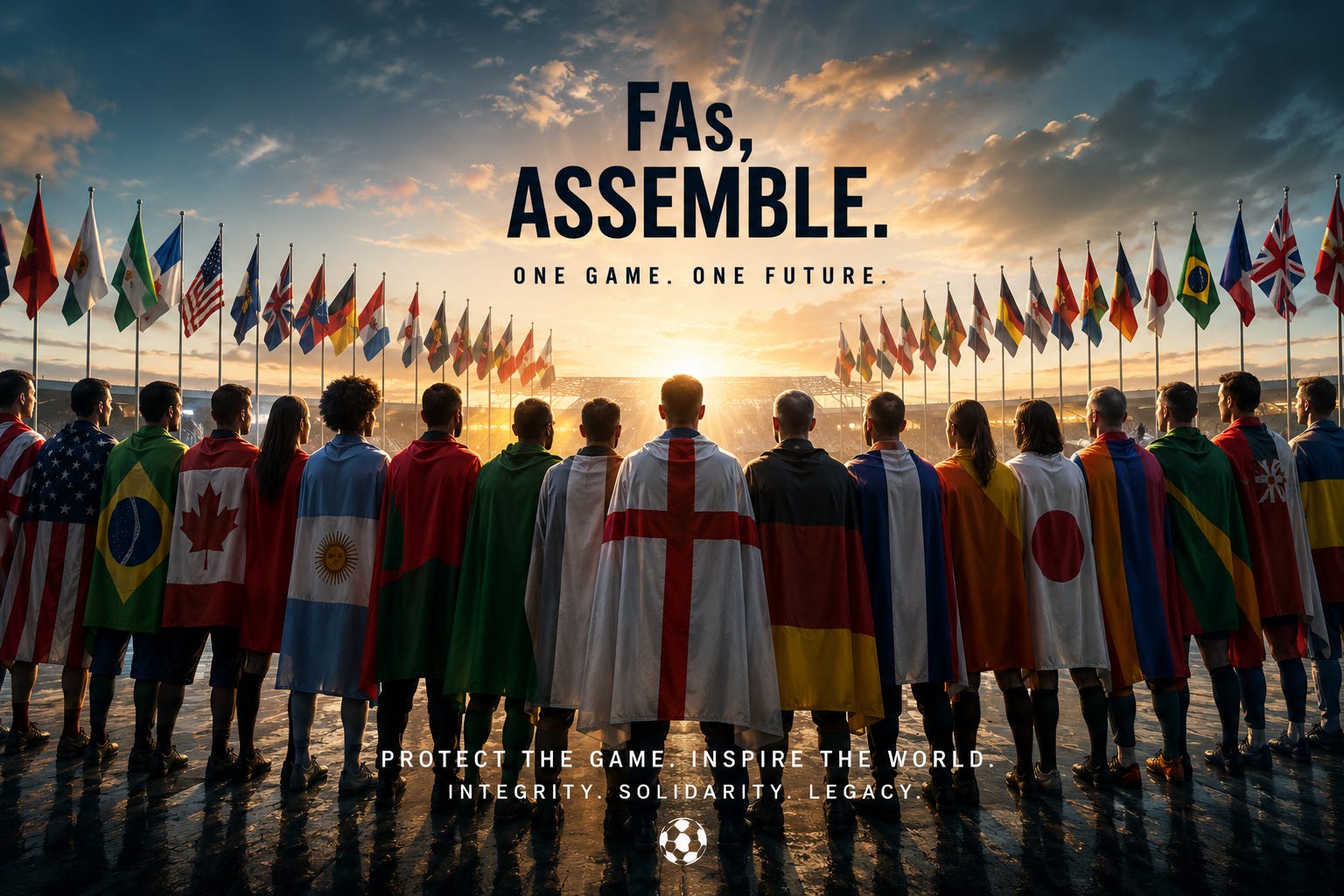
Perhaps this proposal by FIFA is exactly what football needs.
Perhaps creating a commercial entity to unlock billions in new investment will strengthen football for generations.
Perhaps it will provide greater financial security for member associations, expand development funding and help the game embed in newer markets.
Perhaps.
But that isn’t the point, is it?
The point is that football is asking its stakeholders to trust a process at a time when trust is already in limited supply.
And if it is what we need then it should be able to withstand the highest standards of governance.
Despite almost every stakeholder in the game stating they’ve not been consulted or had the opportunity to contemplate such a momentous change (which is wild to me), this proposal did not emerge in a vacuum.
In so many ways, and in hindsight, it is the logical next chapter in a journey FIFA has been on for years.
The World Cup has become increasingly centralized, standardized and commercially sophisticated. Operational control of the event has shifted away from Local Organizing Committees and toward FIFA itself, and so too has the ability to optimize every aspect of the tournament’s commercial value. Often at the expense of legacy.
None of that is inherently wrong of course (although id argue the legacy part is).
Many global organizations have followed a similar path.
But every step toward increasing commercial control also increases the responsibility to demonstrate that decisions are being made in the long-term interests of the game and not simply because they maximize enterprise value.
Once the World Cup became something FIFA could increasingly operate, optimize and control (just after the World Cups in Russia and France), perhaps it was inevitable that it would eventually be viewed as something that could also be sold off for a financial benefit.
But the World Cup is not simply another commercial asset. It is football’s greatest shared inheritance. A sporting celebration that has been built over more than a century by players, clubs, volunteers, supporters and the 211 member associations. FIFA is its steward, not its proprietor.
Again, there is nothing inherently wrong with investment. Nor is there anything wrong with building a more sophisticated commercial structure as long as it ultimately benefits the game.
The question is whether football is approaching this decision in a manner worthy of its significance.
Transformational decisions deserve transformational governance.
That means transparency. Consultation. Independent scrutiny. Time to evaluate competing viewpoints. Confidence that the process is serving the game rather than simply advancing a transaction.
Whether this proposal is ultimately approved or rejected is almost secondary in all this.
The real test is whether football’s stakeholders believe the decision was reached through a process they can ultimately trust.
Let’s face it, there is no shortage of capital in the game.
What it seems to be suffering from is a shortage of confidence in the institutions and leaders entrusted to protect it.
Trust cannot be demanded, it must be earned as the saying goes.
Which brings us to football’s member associations.
Not football’s financiers or commercial partners.
Football Associations.
For far too long, they have been viewed (and have acted the part too), primarily as voting members of an international federation.
It’s time for them to recognize their primary responsibility.
Not to approve deals or oppose change but to ask difficult questions on behalf of the game and the stakeholders they represent.
Who benefits?
What are the risks?
Have all reasonable alternatives been explored?
Will this decision still be considered wise twenty years from now?
Not to simply get in the way of progress but to take their responsibilities of stewardship seriously.
Football should absolutely pursue commercial excellence but that commercial excellence must never eclipse football’s first responsibility — to protect the game itself.
As I said above, the proposal may prove to be exactly what football needs, but if it is then it should withstand the highest standards of governance.
Because the greatest asset in football is not the World Cup.
It is the trust that the world places in those entrusted to protect it.
FAs, Assemble.
Remember when everybody boycotted South Africa
The current state of FIFA is a result of Infantino's infatuation with celebrity and corporatization. FIFA needs neither but he has dragged both his own and the organization's reputation down into the mud with his fascination with both.
Kudos to UEFA and CONCACAF for their clear and quick repudiation of Infantino's plan (and it is entirely his given the fact that Bernd Neuendorf, president of the German Football Association has publicly said he heard nothing about it until he read it in the media). I hope the next 48 hours see the other confederations also make it clear this is a terrible idea. After that, a vote of confidence on Infantino's leadership should be called.
This trending towards celebrity and equity worship needs to be stopped in its tracks.