
A Language That Was Ours
On Public Enemy, Scarborough, and the music that never flinched (hence the Kobe image below) and never let go.

In no way did I discover the music, it found me.
Scarborough in the early 1980s was never the city’s afterthought it was sometimes made out to be. It was a vibrant borough that was alive and dense with sound. My neighbourhood was a diverse one with a deep Caribbean diaspora community that I just happened to be closest to — Jamaican, Trinidadian, Guyanese, etc. — and the music that moved through those households affected me too. Dancehall and reggae blared through the screen doors on balconies. Soca and calypso at block parties and team picnics at Thomson Park. I absorbed all of it. These were my people and this was my soundtrack.
On one afternoon on some summer weekend when I was probably 13-ish years old, Marc Roberts’ dad dropped a needle on a record that shifted everything.
Zapp and Roger Troutman. More Bounce to the Ounce. That bass. That talk box. That feeling that was impossible to name then, and impossible to forget now — that sound could do something to the inside of your chest that I wasn’t aware of. I certainly didn’t have the vocabulary for what I was hearing. I just knew I wasn’t the same person I’d been three minutes earlier.
That moment seemed like a bridge. What I didn’t know was what would be waiting on the other side was a group from Long Island, NY that would pull it all together.
Hip hop in the early 1980s wasn’t ever asking for your permission.
It arrived in the same way all genuinely ‘new’ things seem to arrive — without apology, without explanation, and with a clarity that made everything before it seem like it had been waiting for it. For those of us already living in the margins of the mainstream, already fluent in music that the broader culture either ignored or condescended to, it didn’t feel foreign. It felt in so many ways like a confirmation.
The anti-establishment current ran through everything it touched. And some of that was deeply personal. I was raised by a single mother doing what thousands of single mothers do — carrying more than anyone should have to carry, with less than anyone should have to manage on, and doing it with a dignity that the systems around her neither recognized nor rewarded. All while making sure that those inside it didn’t readily know it. Many in my community were living the same reality. Hip hop didn’t try to romanticize that. It named it. Loudly. Without ever asking whether the people who needed to hear it were comfortable.
For me, that’s what separated it. Not just the sound — though let’s face it, the sound was unlike anything — but the sheer refusal of it all. The deliberate, unapologetic refusal to soften its edges for an audience that had never had to live on those edges. You either heard what it was saying or you didn’t. And the ones who recoiled from it, who called it noise, who said it wasn’t music and who predicted it would disappear — they were telling you something about themselves.
It ran deep along the stretch of Eglinton between McCowan and Markham Roads where we operated. Guys like Dwayne, Leyton, Devon, Paul and I would find anywhere to consume it. It was embedded in crews like Sound Rebound. In the faces like Michee, Maestro, and Rumble. In places across the city like Galloway, Gordonridge, Cataraqui, Mornelle Court, Flemington, Driftwood or at Monster Jams at the Concert Hall where people knew exactly where you were from. On CKLN 88.1 with Ron Nelson on any given Saturday.
We knew what it was. It was ours. And it linked us to Kool Herc. Cold Crush. Sugarhill. Grandmaster Flash. Afrika Bambaataa. RUN DMC. Rakim. Kurtis Blow. LL. The Treacherous Three. KRS One. Salt n’ Pepa. Roxanne. Shan & Marley Marl…
And then came Public Enemy.
Before I dive deeper, I do want to be honest about something else.
The music undoubtedly spoke to me. It energized me. It felt like belonging. All of that was real. But I was also aware — even then, with the incomplete awareness of a kid — that what I was feeling and what my friends were feeling weren’t exactly the same thing.
The racism and hatred they often navigated wasn’t something I had to read about or have described to me from a distance. I saw it. I watched it happen to people I loved. At school, on the street, at soccer games, and in the casual cruelty of systems that processed them differently than they processed me. Our bonds were and in many cases still are genuine and deep, but I wasn’t carrying what they were so often carrying. I knew that. The music named their reality in ways that were visceral and immediate and personal for them in a register I could feel alongside them but never fully claim as my own.
That distinction matters to me and it always has.
What it left me with was something that has really never faded — a permanent sensitivity to who gets seen and who doesn’t. Who the systems are built for and who they quietly exclude. Many of the causes I care most about today, the ones that reverberate differently when I encounter them, have a direct line back to those Scarborough streets, those friendships, those moments of witnessing. You don’t watch the people you care about navigate a world tilted against them and walk away unchanged. Or at least you shouldn’t.
Public Enemy embodied all of this. And they certainly weren’t interested in being polite about it.
Bring the Noise
The first thing I understood about Bring the Noise is that the title was the argument.
Not a song title but an instruction. A challenge of sorts. A direct response to every critic, every programmer, every cultural gatekeeper who had spent years calling hip hop exactly that — noise. That it was unserious. Unmusical. A phase. Chuck D took their dismissal and handed it back, transformed and served into a declaration of war.
Released in 1987, Bring the Noise opens like a door being kicked off its hinges. The Bomb Squad’s production — Hank Shocklee et. al. built a sonic architecture from samples stacked on samples, sirens and scratches and rhythmic fragments colliding at a frequency that was, to say the least, aggressive — it announced immediately that this wasn’t music asking to be accepted. It was music that had already decided it didn’t need your acceptance.
Chuck D’s voice is the instrument that holds it all together. And voice is almost too small a word for what he brings. It’s a force. A physical presence on the track. When he raps he doesn’t perform — he prosecutes. Every line is delivered with the conviction of someone who has thought this through and arrived at a conclusion and is now merely presenting the evidence.
Bass! How low can you go? Death row, what a brother knows.
That opening. Those first bars. They don’t ease you in. They grab you by the scruff of your neck and tell you to pay attention because what follows is going to matter.
What followed was the start of a generation paying attention.
For me, at that age, in that neighbourhood, Bring the Noise was music that felt like it was moving at the speed of what was actually happening around me. Not a reflection of reality — an absolute collision with it. Loud, uncompromising, and completely sure of itself in a way that felt like permission for everyone within earshot to be equally sure of theirs.
Black Steel in the Hour of Chaos
If Bring the Noise kicks your door down, Black Steel in the Hour of Chaos locks you in a room and makes you sit with what’s on the other side.
It is, in my estimation, the greatest narrative rap song ever recorded and I’ll stand on that.
Released on It Takes a Nation of Millions to Hold Us Back in 1988, Black Steel does something almost no hip hop track before or since has done with the same sustained mastery — it tells a complete story, in first person, with a beginning, a middle and an end, and it makes you feel every single moment and transition. This isn’t a song about an idea. It’s a song about a man. A specific man, in a specific impossible situation, making a specific and consequential decision. And for just under six minutes, you are him. At the very least alongside him. All while a haunting, high-pitched piano sampled from Isaac Hayes accompanies you.
The premise is stark. The narrator receives a draft letter from the US government. He refuses to serve. He is imprisoned. He plans and executes a prison break. He escapes — but the ending offers no clean triumph. Just survival. Just the weight of what it cost.
That’s it.
What Chuck D understood — and what made this track so far ahead of its moment — is that the most devastating political statement doesn’t always have to be the loudest one. Sometimes it’s simply the most precise one. Black Steel doesn’t rage against the system in abstract terms. It puts one man inside the machine and shows you exactly what the machine does to him. The personal becomes political not through argument but through a lived experience. You don’t conclude that the system is unjust. You feel that it is.
And there is one moment in the song where that feeling reaches its absolute peak.
As I ventured into the courtyard followed by 52 brothers bruised battered and scarred, but hard.
By the time you arrive at that line you aren’t listening anymore. You’re there. The courtyard is real. Your 52 brothers are real — bruised, battered, scarred, but hard —that word hard, delivered with the slightest of pauses, does more work in a single syllable than many struggle to manage in a paragraph. You can feel the tension of what’s about to happen. You can almost smell the air. The dust and concrete and desperation of men who have decided that whatever comes next, it cannot be worse than what already is. Chuck D doesn’t describe the scene so much as transport you into it. That’s the gift of the truly great narrative artists — not to tell you what something was like, but to make you briefly live it.
The production matches the narrative perfectly. Where Bring the Noise is kinetic and confrontational, Black Steel is slow and suffocating. The Bomb Squad built something that almost feels cinematic here — a track that breathes differently, that has weight and shadow and a kind of relentless forward momentum that mirrors the narrator’s own desperate motion. There’s a haunting quality to it that I’ve never been able to fully explain. It gets into your bones and stays there. It’s that piano. Damn.
I can remember exactly where I was the first time I heard it. That specificity of memory is itself a kind of testimony. Very few pieces of music do that — plant themselves so precisely in a moment that decades later you can still feel the air in the room.
For those of us who had watched people we loved encounter systems that processed them as problems to be managed rather than people to be served, Black Steel wasn’t a metaphor. It was mirror. The draft letter at the song’s opening — an instrument of state power landing in a mailbox, impersonal and absolute — rhymed with a hundred smaller letters, a hundred smaller impositions, that we had witnessed up close. Chuck D just had the genius and the fury to transform it into art.
A mere six minutes to depict a complete world with no resolution that lets you off the hook.
That doesn’t sound like a song, that’s literature.
Fight the Power
Some songs are great. Some songs are important. But very rarely — rarely enough that I am sure you can count on one or two hands the instances — a song becomes both simultaneously and in doing so transcends the category of song entirely and becomes something else. It becomes a cultural object. A timestamp of sorts. A line drawn that symbolizes before this, and after this.
Fight the Power is that.
Released in the summer before I left for university (1989), and written for Spike Lee’s Do The Right Thing — itself (in my opinion) one of the most important American films ever made — Fight the Power arrived not as a standalone track but as an act of cultural intervention. Lee understood what he needed. Not a soundtrack. Not background. He needed music that carried the same charge as the film itself would. Music that made the air crackle and feel hot. Music that a neighbourhood, when needed, could march behind and damn well mean it.
Public Enemy somehow delivered something that exceeded even that brief.
Somewhere in all of this it delivers something essential about hip hop — about what it is at its core, at its most honest — and becomes impossible to ignore. That this is a genre that was built to be experienced live. Flawed. Raw. In and amongst bodies in a crowd, in a specific moment where the bass is physical and the air is shared and something is happening right now that will never happen exactly this way again. The imperfection of it all is not incidental. It is the point. It is the proof. A perfectly produced, perfectly safe, perfectly palatable version of Fight the Power would be a ridiculous contradiction in terms. The rawness is the authenticity. The roughness is the truth. You cannot sand down a reckoning and call it art. It requires a tinge of feedback.
The Bomb Squad built the track from the ground up as a kind of controlled detonation. Layers of sound compressed together until the pressure becomes almost physical. It doesn’t invite you in. It doesn’t build gradually. It begins at full force and stays there, for four minutes and forty seconds, without apology and without relief. Chuck D and Flavor Flav trade lines like Hearns and Hagler. Two men who have been training for this fight their entire lives.
And then there are the lyrics.
Elvis was a hero to most but he never meant shit to me. Straight up racist that sucker was simple and plain…Motherfuck him and John Wayne.
In 1989 that was not a safe thing to say. Elvis Presley and John Wayne were/are American mythology. Untouchable. Sacred. Chuck D looked directly at that mythology and said — on the record, for anyone listening — that mythology built on erasure is not mythology worth protecting. That the story of Elvis and rock and roll, the story of American pop music, had been told with entire communities written out of their own contribution. And he said it without hedging. Without any hint of a qualifier to soften the blow. Without offering anyone even a sense of an escape route.
That willingness to say the true and uncomfortable thing — loudly, precisely, at full volume — is what separated Public Enemy from almost everything around them. They weren’t interested in being tolerated. They were interested in being heard.
For me the song lands differently now than it did then, and yet strangely exactly the same. The anger in it still feels accurate. The demand in it still feels urgent. What has changed is the accumulated weight of everything I now understand about how power actually works — the structures, the incentives, the systems that perpetuate themselves quietly and punish disruption loudly. I’ve spent a career inside those sport specific structures. I know their language. And when Fight the Power comes on — and it still comes on, regularly, without irony — I hear it now with all of that layered underneath.
It doesn’t sound dated, it sounds patient.
Three songs across three years offering three different faces of what seems like the same refusal.
Bring the Noise is a declaration — we are here, we will not be quiet, and your discomfort is certainly not our problem.
Black Steel in the Hour of Chaos is the testimony — here is one man, here is what the machine does to him, here is what it costs to refuse to be consumed by it.
Fight the Power is the demand — not a request, not a petition, an absolute demand — that the story be told honestly and completely, and must include the parts that could even implicate the storytellers.
And what separates all of that from every watered down, focus-grouped, algorithmically optimized imitation that followed — what makes the difference between hip hop that matters and hip hop that merely exists — is exactly that refusal. That reckoning. That unapologetic insistence on truth regardless of who it unsettles.
It all stems from something almost primitively simple. Two turntables. A DJ who understood sound was an instrument. A microphone. And someone willing — and I mean genuinely willing, at personal and professional cost — to step up to that mic and expose themselves and the world they lived in without softening a single edge for the comfort of people who would never have to live it.
That seems like, in a nutshell, the origin. That’s the covenant. Everything authentic in the genre traces back to that moment of exposure. Everything hollow in the genre is hollow precisely because it flinches from it.
Public Enemy never flinched.
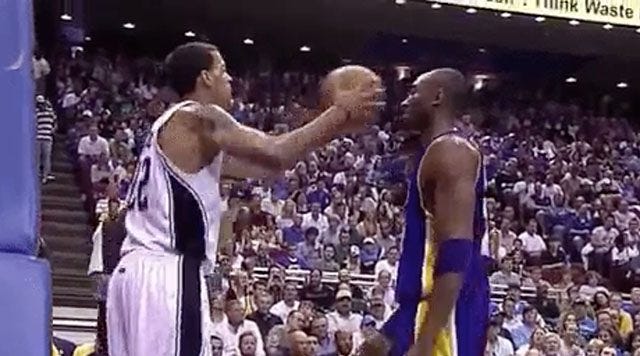
The reason why I chose the image above — where Orlando’s Matt Barnes fakes a hard pass in Kobe Bryant’s face and Kobe doesn’t flinch — is because it perfectly sums up what I’ve been talking about. But it’s also a perfect segue to illustrate something that’s often intertwined with the music that was shaping me. One that I talk about far more often. Sport.
Because sport does what music does. It gets you when you’re young and gets into the body before your mind has a chance to negotiate. It leaves an indelible mark that no amount of coaching or instruction can fully overwrite. The way you play — truly and instinctively play — reflects everything that formed you. Your neighbourhood. Your people. The sounds and rhythms and values that enveloped you before you had words for any of it.
My youth team in Scarborough played a certain way. I know that now in ways I couldn’t have articulated then. There was improvisation in it. Individual expression that somehow cohered into something collective. A relationship to risk that wasn’t reckless but wasn’t timid either. An unflinching willingness to try the unexpected thing, the audacious thing, even when the safer thing was available. We certainly weren’t executing a system. We were expressing something. And what we were expressing had a soundtrack — whether we named it or not.
Watch Brazil and you hear samba. Not as a metaphor. As a literal and cultural transmission — a society’s relationship to rhythm and body and collective joy encoded into the way eleven men move across a pitch together. This didn’t come from a tactics board. It came from the street and the music and the particular Brazilian understanding that beauty and effectiveness are not in opposition, that the most expressive thing is often also the most devastating thing.
Watch modern France and you see the African and Caribbean diaspora remaking what a national team can look like and how it can move — physical confidence, expressive freedom, improvisation within structure. Watch how English football has been transformed as Black British culture stopped being peripheral to the national game and became central to it. The game changed because the people changed. The sound underneath it helped with that change.
Sport and music are both languages the body learns before the mind catches up. You don’t decide to play with flair. You don’t decide to move with rhythm. You play and move the way you’ve been shaped — by community, by sound, by the accumulated weight of everything that got into your bones before you had words for any of it.
Public Enemy got into my bones. But so too did those bumpy Scarborough fields. So did the people I played alongside and the music that moved through all of us. I couldn’t have told you then how those things were connected but have a better understanding and appreciation now.
They were the same thing. Expressed differently but rooted in the same place.
I am certainly not the same person I was in that Scarborough living room when Marc’s dad put a needle on a record and the bass from More Bounce to the Ounce rearranged something inside my chest.
But at the same time I am entirely that person too.
The music that finds you young and finds you truly doesn’t leave. It becomes part of you. It informs how you hear everything that comes after it — not just music, but argument, and injustice, and the particular sound that systems make when they’re working exactly as designed for some people and grinding against others. Public Enemy gave me a language for things I was witnessing but didn’t yet have words for. They gave my friends — who were living those things, not just witnessing them — a mirror that finally showed them something true.
Hip hop at its greatest has always been this. Not just music but a reckoning. A genre that from its earliest days understood that culture is never neutral — that what gets celebrated and what gets ignored, what gets called art and what gets called noise, is always a political act. Public Enemy understood that before most. In many ways they made it their instrument.
I grew up surrounded by people who were navigating a world that didn’t always see them fully. Their music saw them. Completely. Without flinching.
That’s why it never let go.